Workers get hurt every year during equipment servicing—not because machines fail, but because safety procedures aren’t properly documented. The lockout tagout (LOTO) log sheet is not just paperwork; it's a critical component of a functional energy control program. When a technician services a conveyor, resets a hydraulic press, or inspects an electrical panel, the log sheet records who locked out the equipment, when it happened, and what safeguards were applied. Without this traceability, even the best safety protocols collapse under ambiguity.
This article delivers a practical, customizable lockout tagout log sheet template and dives into how to use it effectively across industrial, manufacturing, and maintenance environments. You'll learn what to include, why each section matters, and how to avoid common compliance pitfalls.
What Is a Lockout Tagout Log Sheet?
A lockout tagout log sheet is a formal record used during maintenance or servicing of machinery to document the application and removal of energy isolation devices. It serves as a legal and operational trail confirming that hazardous energy sources—electrical, mechanical, hydraulic, pneumatic, chemical, or thermal—were controlled before work began.
Unlike a one-time LOTO procedure, the log sheet is reused across multiple maintenance events. It tracks each instance of lockout, often stored near the equipment or in a central safety file. Regulatory bodies like OSHA in the U.S. don’t mandate a specific form, but they require documentation that proves compliance with 29 CFR 1910.147.
Why the Log Sheet Isn’t Optional
Imagine a maintenance team servicing a packaging line. One worker applies a lock, but another unknowingly removes it, thinking the work is complete. Power is restored, and someone gets injured. A properly maintained log sheet would have listed all authorized employees involved, their lock IDs, and the expected completion time—preventing premature re-energization.
The log sheet acts as both a communication tool and an audit trail. During inspections, OSHA or internal auditors can review these logs to verify that procedures were followed consistently.
Essential Elements of a LOTO Log Sheet Template
A useful log sheet template isn’t cluttered—it’s designed for clarity and compliance under pressure. Here are the non-negotiable components:
1. Equipment Identification List the machine or system being serviced. Use specific identifiers like: - Equipment name (e.g., “Conveyor Line 3”) - Location (e.g., “North Production Floor, Bay B”) - Asset or serial number
Avoid vague entries like “Production Machine.” Precision prevents confusion during shift changes.
2. Date and Time of Lockout Record when each lock is applied and when the equipment is cleared for restart. Include both start and estimated completion times. Real-world example: A technician logs a lock at 9:15 AM with an expected release at 11:00 AM. If the work runs late, this signals the need for updates or shift handover.
3. Authorized Employee Information Each worker applying a lock must be listed. Include: - Full name - Employee ID - Department - Contact information (optional, but helpful for shift overlaps)
This ensures accountability. If a lock remains after hours, supervisors can identify who applied it.
4. Lock and Tag Details Track each lock and tag used:
- Lock number or ID
- Tag number
- Type of energy source isolated (e.g., electrical, hydraulic)
Some facilities use color-coded locks per department. The log should reflect this system.
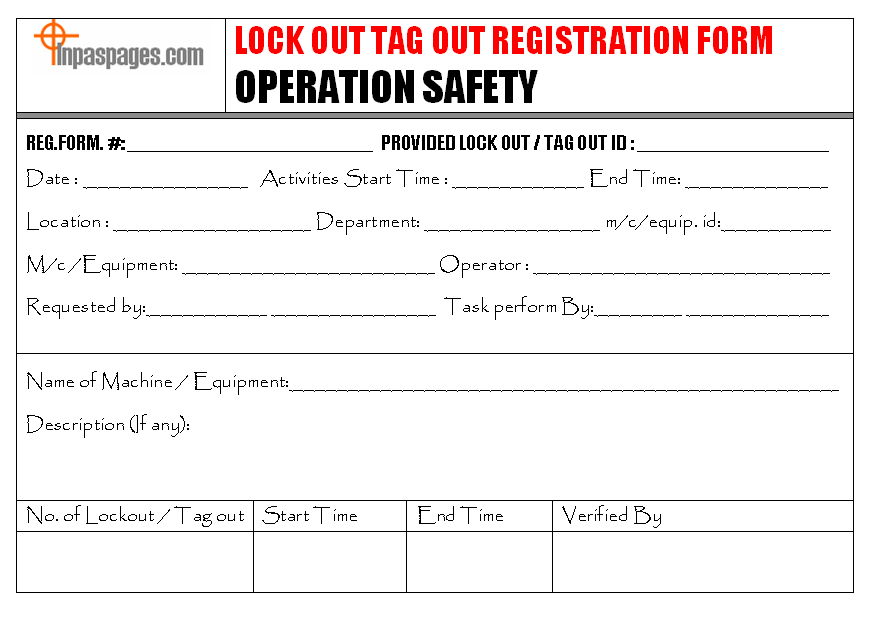
5. Reason for Lockout A short description of the maintenance task—e.g., “Replace drive belt,” “Inspect motor wiring,” or “Clear jam in auger feeder.” This helps other workers understand why the equipment is down.
6. Verification of Isolation A checkbox or signature line confirming that zero energy was verified before work began. This is a key OSHA requirement: simply locking a device isn’t enough—you must test that the energy is gone.
7. Removal Authorization Final section for documenting the clearance process:
- Name of each person removing a lock
- Time of removal
- Supervisor verification (if required)
No lock should be removed without confirming all workers are clear and the system is safe to restart.
Downloadable Lockout Tagout Log Sheet Template
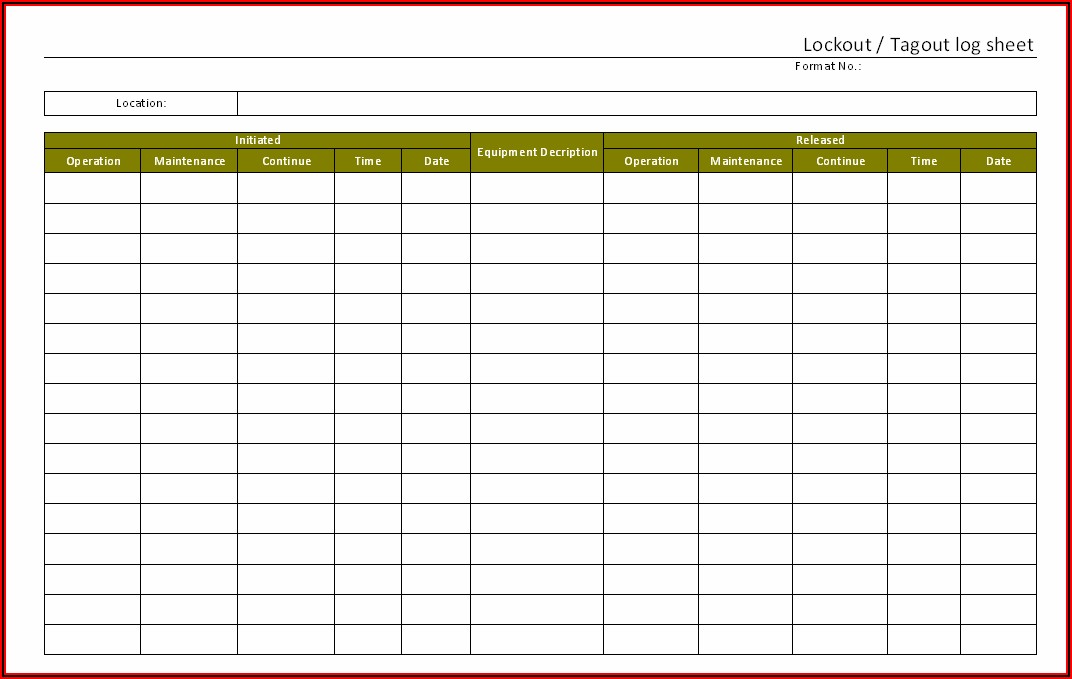
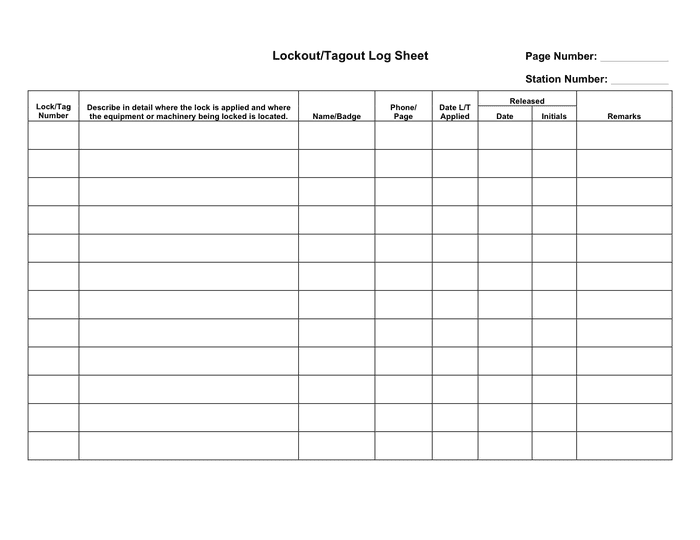
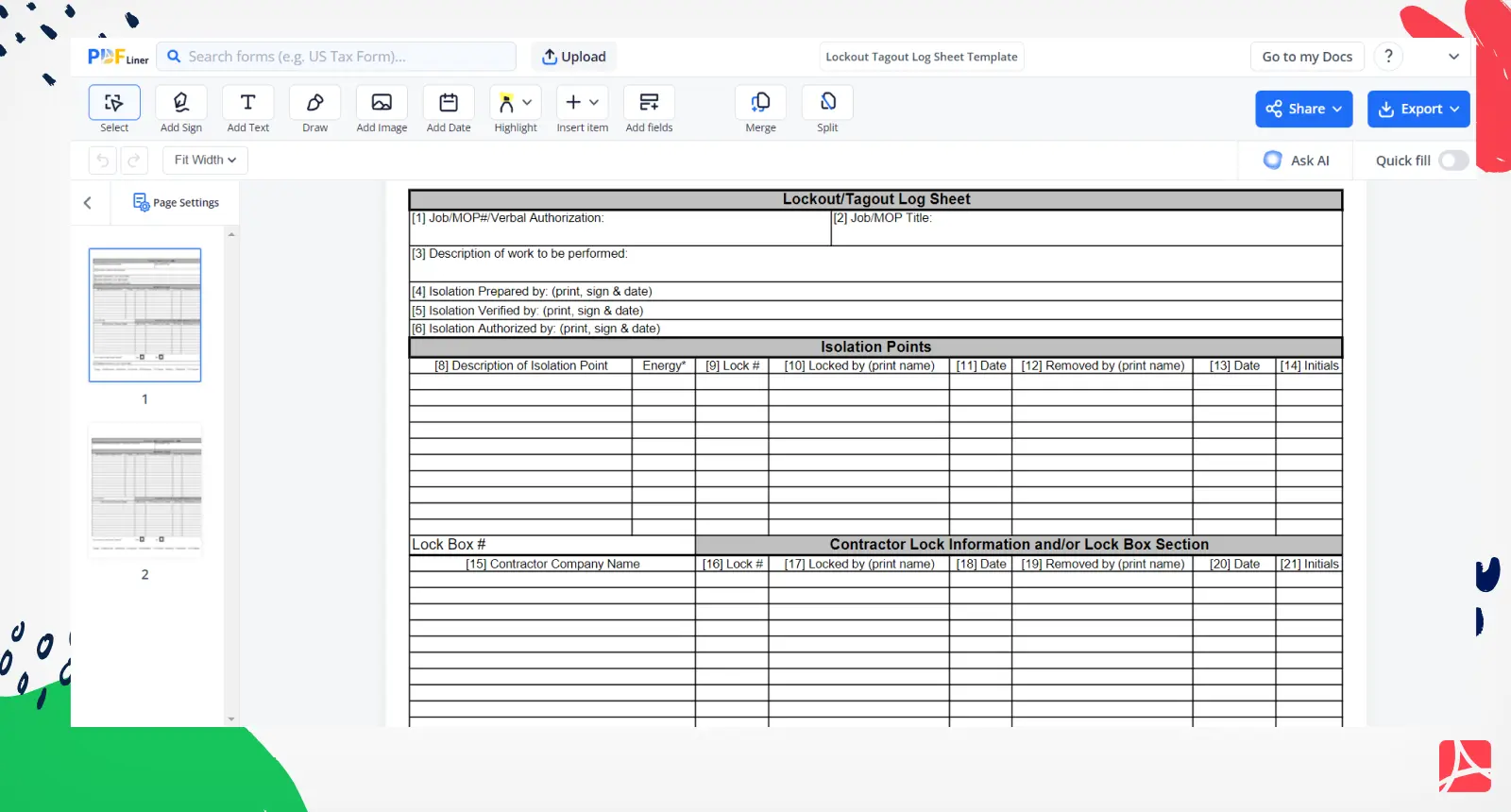
Below is a clean, editable template you can adapt for your facility. It’s designed for printing or digital use in tablets or maintenance kiosks.
text LOCKOUT TAGOUT LOG SHEET
Equipment: _________________________ Location: _________________________ Asset No: ___________________________ Work Request #: ___________________
Date: __________ Lock Applied: _________ Expected Completion: _________
| Employee Name | ID | Dept | Lock ID | Tag ID | Energy Source | Task Description |
|---|---|---|---|---|---|---|
Isolation Verified? ☐ Yes Signature: ___________ Time: _________
Additional Notes: _________________________________________________________
| REMOVAL RECORD | ||||
|---|---|---|---|---|
| ---------- | --------- | -------------- | --------------------------- | ----------- |
Equipment cleared for operation: ☐ Yes Time: _________ By: __________
This template avoids unnecessary fields while ensuring OSHA alignment. Modify column labels based on your LOTO program—some sites add shift numbers or permit references.
Common Mistakes That Undermine LOTO Logs
Even with a solid template, human error can compromise safety. Here are recurring issues:
❌ Incomplete Sign-Offs A worker forgets to sign the removal section. Later, a supervisor assumes the lock was removed, but it’s still in place. Always verify that every lock applied is accounted for in the log.
❌ Missing Verification Step Technicians rush to start work and skip testing for zero energy. The log must include a signed verification line—this isn’t optional. Test voltage, bleed lines, or manually check moving parts.
❌ Poor Visibility Posting the log inside a locked panel or storing it on a distant server defeats its purpose. The log must be accessible to all affected personnel. Use laminated sheets near equipment or digital tablets mounted nearby.
❌ Reusing Entries Never copy-paste previous log entries. Each lockout is a unique event. Recurring tasks still require fresh documentation.
❌ Ignoring Group Lockouts In team maintenance, each worker must apply their own lock and be listed individually. A single “team lead” entry isn’t compliant.
How to Integrate the Log Sheet Into Your Safety Workflow
The template alone won’t improve safety—it’s how you use it. Follow this process:
- Pre-Work Briefing: Gather all authorized employees. Review the task, energy sources, and log sheet setup.
- Shut Down Equipment: Follow shutdown procedures in sequence.
- Isolate Energy Sources: Apply locks and tags. Record each immediately on the log.
- Verify Zero Energy: Test circuits, relieve pressure, or confirm mechanical stops.
- Begin Work: Proceed only after verification and logging.
- Remove Locks: Each worker removes their own lock after confirming the area is clear.
- Final Clearance: Supervisor reviews the log, confirms all locks are removed, and authorizes restart.
Store completed logs for at least one year—OSHA may request them during audits.
Digital vs. Paper LOTO Log Sheets: Which Works Better?
More facilities are switching to digital log systems. Here’s how they compare:
| Feature | Paper Logs | Digital Logs |
|---|---|---|
| Accessibility | Limited to physical location | Accessible via tablet or app |
| Real-time Updates | Delayed | Instant updates across teams |
| Audit Readiness | Requires scanning/filing | Auto-saved, searchable records |
| Error Prevention | Manual entry risks | Mandatory fields and validation |
| Integration | Standalone | Can sync with CMMS or EAM tools |
| Training Curve | Low | Moderate (requires tech literacy) |
Digital options like Failsafe LOTO, Sphera LOTO, or iAuditor by SafetyCulture offer mobile log entries, photo attachments, and automated alerts. However, paper remains viable if stored properly and consistently used.
For small shops or infrequent maintenance, paper works. For complex plants with multiple shifts, digital systems reduce errors and improve traceability.
Real-World Use Cases
Case 1: Manufacturing Plant Prevents Near-Miss At a Midwestern automotive parts facility, a night-shift technician began work on a stamping press. The log sheet showed a lock applied by a day-shift electrician who had left early due to illness. The supervisor contacted the employee, confirmed the lock was still active, and delayed restart—avoiding a potential accident.
Case 2: Food Processing Facility Fails OSHA Audit During an inspection, OSHA found incomplete logs with missing verification signatures. The facility was cited under 1910.147(c)(6)(i) for failure to document LOTO procedures. After adopting a standardized template with mandatory sign-offs, they passed the follow-up audit.
These cases show that the log sheet isn’t just administrative—it’s a frontline defense.
Final Thoughts: Make Your LOTO Log Sheet Actionable
A lockout tagout log sheet template is only as good as its execution. Don’t treat it as a compliance checkbox. Train your team to see it as a communication tool—a living document that protects lives.
Customize the provided template to fit your operations. Print it, post it, or load it into a digital system. Review logs weekly. Use them in safety meetings to highlight gaps or successes.
The goal isn’t just to meet OSHA standards. It’s to create a culture where every lock has a story, every tag has a purpose, and every log entry reinforces a safer workplace.
Start today: download the template, run a mock LOTO drill, and verify your team can complete the log accurately under real conditions. Safety isn’t perfect on paper—it’s proven in practice.
FAQ
Why do I need a LOTO log sheet if I already have a lockout procedure? The procedure explains how to lock out equipment. The log sheet proves it was done correctly for each event. OSHA requires documentation of each instance.
Can I use the same log sheet for multiple machines? No. Each machine or system requires its own log during servicing. Cross-referencing can cause confusion and safety risks.
Who should keep the LOTO log sheet? It should be kept near the equipment being serviced or in a central safety station. All authorized and affected employees must have access.
How long should I keep completed log sheets? OSHA requires documentation of periodic inspections every 12 months, but retaining logs for at least one year is standard practice for audits.
Can a digital log sheet be legally binding? Yes, if it includes electronic signatures, timestamps, and cannot be altered after submission. Ensure your system meets record-keeping requirements.
What happens if a worker forgets to sign the removal section? Treat the lock as still active. Do not re-energize the equipment until the worker is contacted and the log is corrected.
Should contractors be included in the LOTO log? Absolutely. Any outside worker performing servicing must be listed, apply their own lock, and sign the log—just like internal staff.
FAQ
What should you look for in Lockout Tagout Log Sheet Template for Safety Compliance? Focus on relevance, practical value, and how well the solution matches real user intent.
Is Lockout Tagout Log Sheet Template for Safety Compliance suitable for beginners? That depends on the workflow, but a clear step-by-step approach usually makes it easier to start.
How do you compare options around Lockout Tagout Log Sheet Template for Safety Compliance? Compare features, trust signals, limitations, pricing, and ease of implementation.
What mistakes should you avoid? Avoid generic choices, weak validation, and decisions based only on marketing claims.
What is the next best step? Shortlist the most relevant options, validate them quickly, and refine from real-world results.